10 Montessori Kindergarten Activities Ideas

10 Montessori Kindergarten Activities Ideas

The Montessori method, developed by Maria Montessori, focuses on child-led learning, independence, and hands-on exploration. In a Montessori kindergarten environment, children learn through meaningful activities that encourage curiosity, creativity, and problem-solving skills. These activities are carefully designed to match a child’s developmental stage while promoting concentration and confidence.
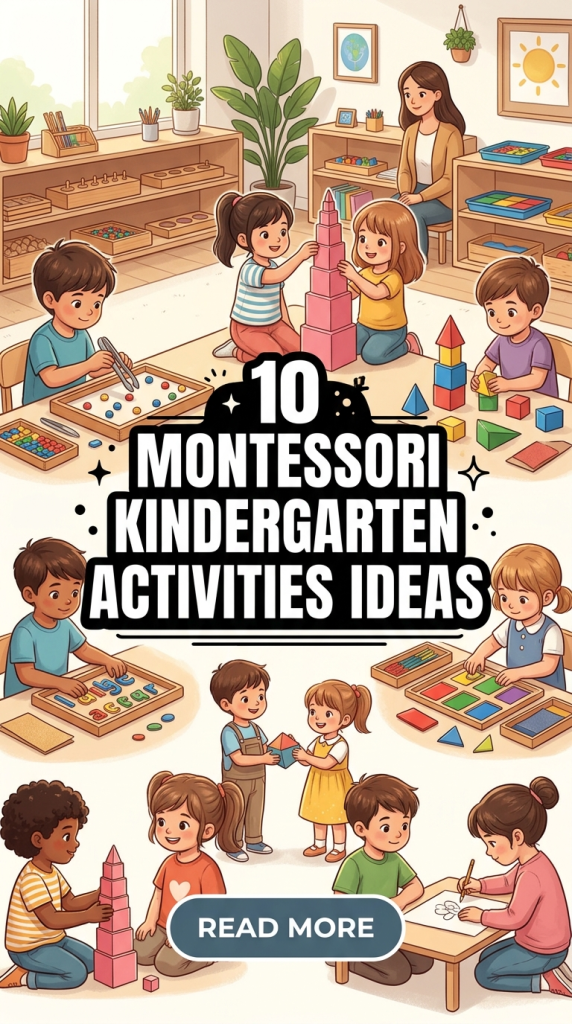
If you’re looking to create a Montessori-inspired learning experience at home or in the classroom, here are ten engaging and effective activity ideas that align with Montessori principles.


1. Practical Life: Pouring and Transferring

This activity involves pouring water, rice, or beans from one container to another using small pitchers, spoons, or cups.

Children develop hand-eye coordination, focus, and fine motor skills through repetition. Start with larger objects and gradually move to smaller items for more precision. This activity also builds independence as children learn to handle everyday tasks.


2. Sensorial Play: Color Sorting

Provide children with colored objects like beads, buttons, or fabric pieces and ask them to sort them into matching groups.

This activity enhances visual discrimination and helps children understand colors and patterns. You can increase complexity by introducing shades and gradients.


3. Language Development: Sandpaper Letters

Sandpaper letters allow children to trace alphabets with their fingers while saying the sound aloud.

This multi-sensory experience strengthens memory and connects physical movement with language learning. It is a foundational Montessori activity for early reading and writing skills.


4. Math Skills: Number Rods

Number rods are wooden rods of varying lengths used to teach counting and number concepts.

Children arrange rods in order and count segments, helping them visually and physically understand numerical values. This makes abstract math concepts more concrete and easier to grasp.


5. Nature Exploration: Leaf Matching

Take children outside to collect leaves, then match them with pictures or sort them by shape and size.

This activity builds observation skills and fosters a connection with nature. It also introduces basic science concepts like classification and comparison.


6. Fine Motor Skills: Bead Stringing

Provide colorful beads and strings for children to create necklaces or patterns.

This simple yet engaging activity improves finger strength, coordination, and concentration. It also allows for creative expression as children design their own patterns.


7. Practical Life: Cleaning Activities

Give children child-sized cleaning tools like brooms, cloths, or spray bottles.

Let them clean tables, wipe surfaces, or arrange items neatly. These tasks teach responsibility, independence, and care for the environment—core Montessori values.


8. Cultural Learning: Puzzle Maps

Montessori puzzle maps introduce children to geography in a hands-on way.

Children learn about continents, countries, and their shapes by placing puzzle pieces correctly. This builds spatial awareness and early global understanding.


9. Creative Expression: Open-Ended Art

Instead of structured crafts, provide materials like paper, paint, clay, and crayons without strict instructions.

Children explore their creativity freely, which boosts imagination and self-expression. Montessori encourages process over product, allowing children to enjoy creating rather than focusing on results.


10. Grace and Courtesy: Role-Playing

Teach social skills through role-playing scenarios like greeting others, saying “thank you,” or sharing toys.

This helps children develop emotional intelligence, empathy, and communication skills. These lessons are essential for building positive relationships.


Conclusion

Montessori kindergarten activities are designed to nurture the whole child—intellectually, emotionally, socially, and physically. By incorporating these hands-on, purposeful activities into daily routines, children develop independence, confidence, and a lifelong love for learning. The key is to provide a prepared environment where children can explore freely while being gently guided.

These activities are simple to set up yet highly impactful, making them perfect for both classrooms and home learning spaces. With consistency and encouragement, children can thrive in a Montessori-inspired environment.

Comments

No comments yet. Why don’t you start the discussion?

Leave a Reply

Your email address will not be published. Required fields are marked *