A shelf of books leaning sideways like dominoes waiting to fall is one of those small annoyances that quietly chips away at a room’s calm. Bookends fix that in seconds, and the store-bought versions are often either plain or pricey. Making your own solves both problems at once, and it gives you a chance to echo the colors, textures, and mood of the room instead of settling for whatever the shelf aisle had left.
The 10 DIY bookend ideas for bookshelves below range from a quick afternoon project with a thrifted brick to a slow, satisfying resin pour. Some use materials you probably already have in the garage or recycling bin. Others ask for a specialty mold or a bag of concrete, but nothing here requires a workshop full of tools or years of practice.
What ties them together is weight and personality. A bookend has one job — to hold a row of books upright — but it can also be a small piece of sculpture, a memory, or a hint of the season. Pick one project, or mix a couple of styles across different shelves, and watch how much steadier and more intentional the whole room feels.
Quick Answer
To make your own bookends, choose a heavy base material — concrete, stone, brick, or a fabric pouch filled with rice or steel shot — then decorate it to match your space. Most of these 10 DIY bookend ideas for bookshelves can be finished in under two hours with basic craft supplies, and each one can be painted, sealed, or upholstered so it suits a modern, rustic, coastal, or kid-friendly shelf.
1. Cast Concrete Hexagon Bookends
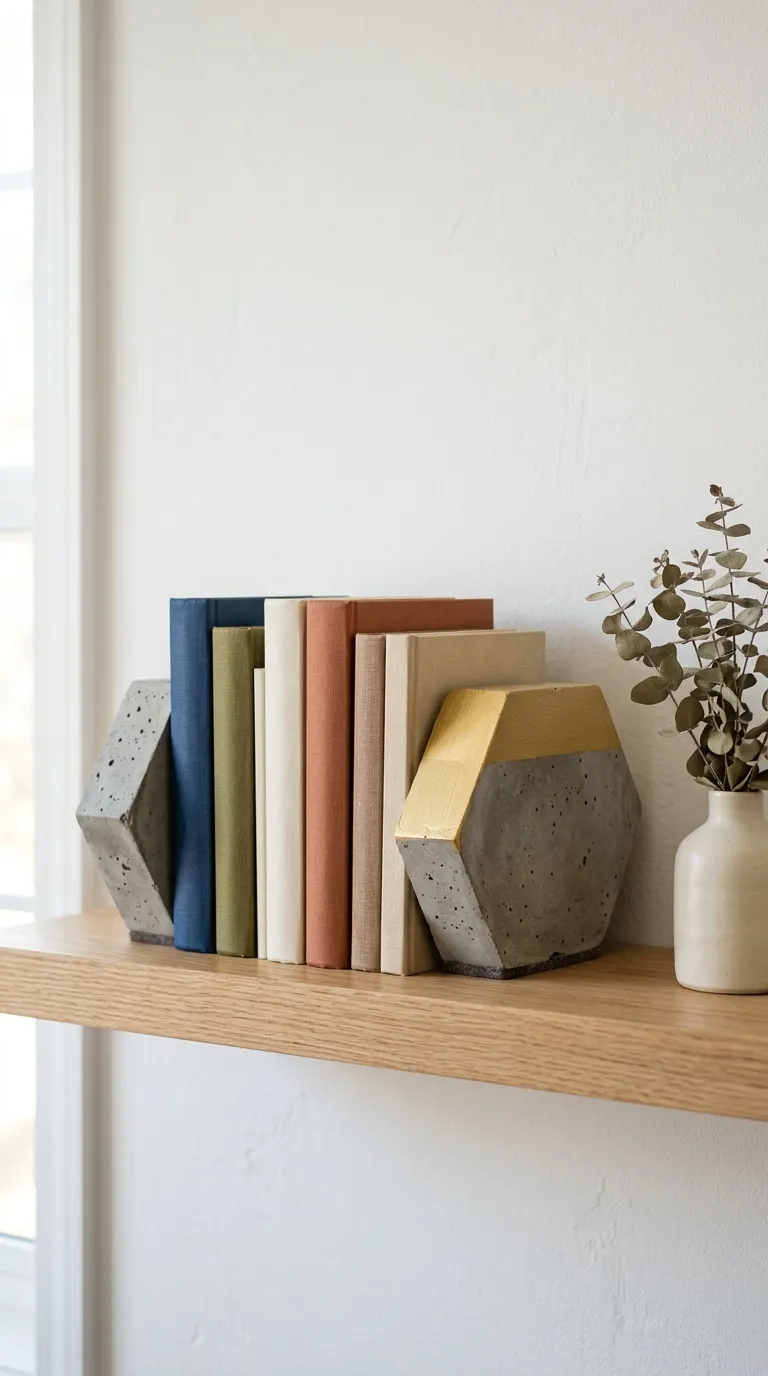
Concrete has a quiet, architectural presence that suits a shelf full of paperbacks and hardcovers alike. A pair of hexagon castings reads modern without shouting, and because you pour them yourself, you decide the color, the finish, and how much weight each one carries.
Materials:
- Rapid-set concrete mix (a small bag makes several pairs)
- Silicone hexagon mold or a waxed cardboard carton
- Cooking spray or mold release
- Mixing bucket and stir stick
- Fine-grit sandpaper
- Self-adhesive felt pads
- Optional: concrete sealer, acrylic paint, metallic wax
How to make them: Mist the mold with release spray. Mix the concrete with just enough water to reach a thick brownie-batter consistency — extra water weakens the finished piece and makes it crumble. Fill the mold in two layers, tapping the sides firmly after each one to coax trapped air to the surface. Let it cure for 24 hours, unmold, then sand the edges until they feel smooth. Seal the surface if the bookends will sit near a window or in a humid room, and add felt pads to the base.
Time: around 45 minutes of hands-on work, plus curing. Difficulty: beginner-friendly, though the water ratio matters more than beginners expect.
For customization, brush on a wash of acrylic paint and wipe most of it back off to bring out the texture, or leave the concrete bare and paint only the top face in a single bold color. A gold-painted edge gives the pair a boutique look. Display them in a living room on a shelf of design books, or in a home office where the neutral gray blends with nearly any color scheme.
💡 Pro Tip: If your first pour feels light, it will slide instead of support. A hexagon roughly four inches across and two inches deep usually lands around a pound and a half, which is enough for a small stack of paperbacks but not a full row of hardcovers.