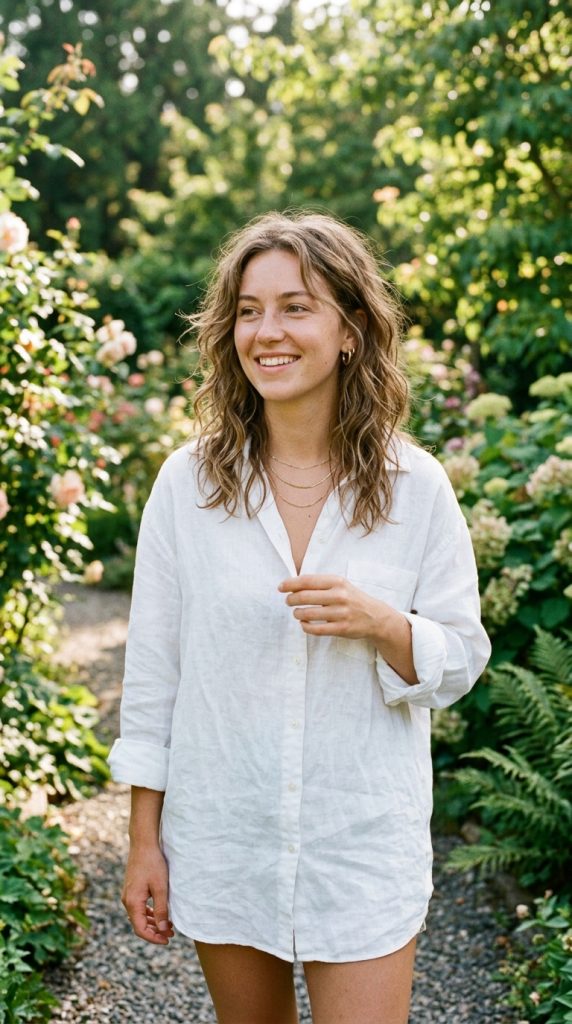
10. The Effortless Air-Dried Shag
The Vibe: Natural, low-maintenance, effortlessly beautiful, and deeply relaxed.
Not every shag needs heat tools, products, and a twenty-minute morning routine. The effortless air-dried shag is designed specifically to look its best when it’s done as little as possible. It relies on a very specific cut — one that accounts for how the hair dries naturally — and a minimal product routine that enhances rather than overrides the hair’s natural movement and texture. For fine hair, this is a revelation: a style that actually looks better when you do less.
What Makes It Work for Fine Hair:
Fine hair that is allowed to air dry with minimal product tends to dry lighter, with more natural movement and texture, than fine hair that is blow-dried or heat-styled. A shag cut that is designed for air-drying uses this to its advantage — the layers are cut in a way that creates movement when the hair dries naturally, the choppy ends add texture without any additional styling, and the whole result is a style that looks like it was made for exactly the way the hair naturally behaves.
How to Ask for It:
Tell your stylist you want a shag cut specifically designed for low-maintenance air-drying. Ask for the layers to be cut with air-drying in mind — this means the stylist will account for how your particular hair type dries naturally, rather than cutting for a blow-dried finish. Request lots of internal layering, piece-y ends, and face-framing sections.
How to Style It:
Wash your hair and gently squeeze out excess water with a microfiber towel — never rub fine hair with a regular towel, as this causes frizz and breakage. Apply a small amount of a lightweight air-dry cream or a curl-enhancing cream if you have any natural wave. Scrunch gently and leave completely alone until dry. Once fully dry, apply the smallest possible amount of a dry texturizing spray at the roots and shake out with your fingers.
Pro Tips:
- The single most important product for this style on fine hair is a lightweight air-dry cream — it adds just enough definition and frizz control without weighing fine hair down
- Flipping your head upside down while the hair air-dries creates volume at the roots that wouldn’t develop if the hair dried hanging straight down
- This style looks best on fine hair that has at least some natural wave or texture — completely straight fine hair may need a tiny amount of light mousse to give the air-dried result some shape
- Going from wet to dry in this style genuinely takes zero effort — it’s the perfect style for mornings when you simply don’t have time
Best For: Fine wavy or slightly textured hair at any length.
Occasion: Everyday wear, weekends, low-maintenance lifestyle, any occasion where natural beauty is the goal.
The Essential Products for Fine Hair Shag Styling
Fine hair is uniquely sensitive to products. Too much product and fine hair is weighed down, greasy, and flat. Too little and it has no hold, no texture, and no life. Here is the complete product toolkit for maintaining and styling a shag on fine hair:
Volumizing Mousse — The foundation product for fine hair styling. Apply to damp roots and work through to the ends. Look for a lightweight formula specifically designed for fine or thin hair — heavy mousses will flatten rather than lift. Apply the equivalent of a golf ball-sized amount before blow-drying any shag style.
Root-Lifting Spray or Root Boost Foam — Sprayed directly at the roots before blow-drying, this product gives fine hair the root lift it cannot create on its own. It’s different from mousse — it specifically targets the root area and provides structural support at the scalp level. It is transformative for fine hair.
Dry Texturizing Spray — Applied to the roots and mid-lengths of dry, styled hair, this product adds grip, volume, and texture between washes. It’s the secret weapon for making fine hair shag styles look full and styled on day two and three. A few quick pumps and a shake-out with the fingers can completely refresh a fine hair shag.
Lightweight Pomade or Hair Wax — Used sparingly on the very ends of dry hair to define the piece-y, textured ends that are the signature of the shag. On fine hair, use the tiniest possible amount — a grain-of-rice sized piece worked between the fingertips before raking through the ends.
Sea Salt or Texturizing Spray — Applied to damp hair before air-drying or diffusing, this adds the grip and grit that fine hair lacks naturally. It enhances any natural wave and helps the layers of a shag sit separately rather than clumping together.
Flexible-Hold Hairspray — A light-hold spray over a finished shag style protects the volume and texture without making fine hair stiff or crunchy. Look specifically for formulas that say “light hold” or “flexible hold” — heavy-hold sprays crush the volume that fine hair shag styling works so hard to create.
Volumizing Shampoo and Conditioner — The foundation starts in the shower. Use a volumizing or strengthening shampoo that adds body rather than moisture-weight. Condition only from the mid-lengths to the ends — applying conditioner to the roots of fine hair flattens it immediately.
How to Talk to Your Stylist About a Fine Hair Shag
Many people with fine hair have had the experience of leaving a salon with a shag that immediately falls flat — and the problem is almost always in the communication rather than the stylist’s skill. Here’s exactly what to say:
Say: “I have fine hair and I want a shag with heavy layering that starts at the crown, not halfway down the head.”
Say: “Please use point-cutting or razor-cutting on the ends — I don’t want any blunt lines.”
Say: “I want the layers to be dramatic and visible, not subtle — my hair is fine so I need the layering to do real work.”
Say: “My main concern is volume at the roots and texture at the ends — I want the cut to do as much of that work as possible.”
Don’t say: “Can I have some layers?” — This is too vague for a fine hair shag. You need specifics.
Always bring: Reference photos from Pinterest that show the exact style you want. Images communicate what words often can’t, especially for a cut with as many variables as the shag.
Quick Reference: 10 Shag Hairstyles for Fine Hair
| Style | Best Length | Key Feature | Skill Level | Time to Style |
|---|---|---|---|---|
| Classic 70s Shag | Medium to long | Maximum layering throughout | Beginner | 20 min |
| Modern Wolf Cut Shag | Short to medium | Disconnected crown layers | Beginner | 15 min |
| Curtain Bang Shag Bob | Chin to jaw | Face-framing curtain bangs | Beginner | 15 min |
| Pixie Shag | Very short | Crown lift, textured ends | Beginner | 10 min |
| Layered Lob Shag | Collarbone to shoulder | Versatile internal layering | Beginner | 20 min |
| Shaggy Fringe Bob | Chin to jaw | Full fringe density | Intermediate | 20 min |
| Textured Shag + Money Piece | Any length | Color contrast for dimension | Beginner | 20 min |
| Short Shag + Defined Curtain Bangs | At or above chin | Precision curtain bang styling | Intermediate | 20 min |
| Retro Shag with Flipped Ends | Chin to collarbone | Vintage flipped end silhouette | Intermediate | 25 min |
| Effortless Air-Dried Shag | Any length | Zero heat, minimal product | Beginner | 0 min (air dry) |
Frequently Asked Questions About Shag Hairstyles for Fine Hair
Is a shag haircut good for fine hair? The shag haircut is one of the best haircuts specifically for fine hair. The heavy internal layering, choppy ends, and crown layers all work structurally to add volume, movement, and texture that fine hair lacks on its own. A well-executed shag on fine hair can be completely transformative.
Will a shag make fine hair look thinner? When done correctly, a shag does the opposite — it makes fine hair look fuller and more textured. The key is ensuring the layers start at the crown rather than halfway down the head, and that the ends are point-cut or razor-cut rather than blunt. A blunt cut on fine hair looks thin; a layered, textured shag looks full of life.
What length shag is best for fine hair? The lob length — sitting at or just above the collarbone — is widely considered the most flattering length for fine hair shag styles. It’s long enough to show movement and versatility but short enough that layering can do real structural work. That said, every length on this list works — from the pixie shag to the longer classic 70s shag.
How often do shag haircuts need to be trimmed? Most shag haircuts need trimming every six to eight weeks to maintain the shape and prevent the layers from growing out into a shapeless, heavy style. Styles with curtain bangs or fringe need more frequent trims — every three to four weeks — to keep the bangs in their optimal shape.
What is the difference between a shag and a wolf cut? A wolf cut is a modern evolution of the shag. The wolf cut typically features more extreme disconnection between the crown layers and the bottom layers, creating a more dramatic volume contrast at the top. A traditional shag has a more graduated, flowing layer structure. Both work beautifully for fine hair — the wolf cut creates more dramatic root volume, while the traditional shag creates more all-over movement.
What products are absolutely essential for a fine hair shag? The three most essential products for fine hair shag styling are a volumizing mousse applied to damp roots before blow-drying, a root-lifting spray for structural support at the scalp, and a dry texturizing spray applied to dry hair for between-wash volume and grip. These three products can completely transform the way a shag looks on fine hair.
Final Thoughts
Fine hair and shag hairstyles are one of the great partnerships in all of hair styling — a combination where every element of the cut works in favor of the hair’s natural characteristics rather than fighting against them. The layering adds body. The textured ends add visual density. The crown layers add lift. The overall result is a head of hair that looks dramatically fuller, more textured, and more alive than fine hair ever gets to look in a blunt, un-layered cut.
The 10 shag hairstyles for fine hair ideas in this guide span the full range of lengths, personalities, and styling preferences — from the bold and maximalist pixie shag to the effortless air-dried version that does all its work while you sleep. There is something here for every fine-haired person, and every style on this list has the potential to be genuinely life-changing for the right person.
Talk to your stylist, bring your reference photos, invest in the right products, and get ready to see your fine hair in a completely new light.
Save this guide, pin your favorites, and share it with every fine-haired person you know who has been told their hair can’t do much. It can. It just needed the right cut.